-
Adverse Reactions
Most common (≥20%*) adverse reactions in chemorefractory patients with WT KRAS† mCRC1
System Organ Class Preferred Term Vectibix + BSC (n=123) BSC alone (n=120) Any Grade
n (%)Grade 3–4
n (%)Any Grade
n (%)Grade 3–4
n (%)Gastrointestinal disorders Diarrhea 30 (24) 3 (2) 13 (11) NR General disorders and administration site conditions Fatigue 40 (33) 6 (5) 15 (13) 4 (3) Infections and infestations Paronychia 41 (33) 4 (3) NR NR Respiratory, thoracic, and mediastinal disorders Cough 24 (20) NR 9 (8) NR Skin and subcutaneous tissue disorders Erythema 86 (70) 10 (8) 1 (<1) NR Pruritus 83 (67) 4 (3) 2 (2) NR Dermatitis acneiform 72 (59) 9 (7) 1 (<1) NR Rash 25 (20) 2 (2) 1 (<1) NR Exfoliative rash 31 (25) 4 (3) NR NR Skin fissures 30 (24) 3 (2) NR NR Adapted from the Product Monograph.1Most common (≥20%*) adverse reactions in patients with WT RAS mCRC1
System Organ Class Preferred Term Vectibix + BSC (n=72) BSC alone (n=64) Any Grade
n (%)Grade 3–4
n (%)Any Grade
n (%)Grade 3–4
n (%)Gastrointestinal disorders Diarrhea 16 (22) NR 5 (8) NR General disorders and administration site conditions Fatigue 28 (39) 2 (3) 9 (14) 1 (2) Infections and infestations Paronychia 30 (42) 4 (6) NR NR Respiratory, thoracic, and mediastinal disorders Cough 15 (21) NR 5 (8) NR Skin and subcutaneous tissue disorders Pruritus 51 (71) 4 (6) 2 (3) NR Erythema 49 (68) 4 (6) 1 (2) NR Dermatitis acneiform 45 (63) 5 (7) NR NR Skin fissures 22 (31) 1 (1) NR NR Exfoliative rash 21 (29) 2 (3) NR NR Adapted from the Product Monograph.1

CHARACTERISTICS
* In the Vectibix + BSC arm.
† KRAS (exon 2).
BSC, best supportive care; KRAS, Kirsten rat sarcoma viral oncogene homologue; NR, not reported in the Vectibix Product Monograph; mCRC, metastatic colorectal cancer;
RAS, Rat sarcoma viral oncogene homologue; WT, wild-type.
All patients (n=463)4,5
| Characteristics | Vectibix + BSC (n=231) | BSC alone (n=232) |
|---|---|---|
| Age | ||
| Mean age (range), years | 61.2 (10.3) | 61.4 (10.8) |
| Gender | ||
| Male (n) | 146 | 148 |
| Female (n) | 85 | 84 |
| Ethnicity | ||
| White (%) | 99 | 98 |
| Primary Tumour Type | ||
| Colon (%) | 66 | 68 |
| Rectal (%) | 34 | 32 |
| All patients (n=463) | ||
| Eastern Cooperative Oncology Group (ECOG) Performance Status | ||
| 0 | 40% | |
| 1 | 45% | |
| 2 | 14% | |
| 3 | 1% | |
| Prior fluoropyrimidine, irinotecan, and oxaliplatin chemotherapy | ||
| 2 lines | 100% | |
| 3 lines | 37% | |
| >3 lines | 6% | |
- ≥18 years old with pathologic diagnosis of metastatic colorectal adenocarcinoma and radiologic documentation of disease progression during or within 6 months following the last administration of fluoropyrimidine, irinotecan, and oxaliplatin.
- Adequate exposure to prior chemotherapy, with average dose-intensity of irinotecan (≥65mg/m2 per week) and of oxaliplatin (≥30mg/m2 per week).
- Two or three prior chemotherapy regimens for metastatic colorectal cancer.
- Eastern Cooperative Oncology Group (ECOG) performance status (PS) of 0–2.
- ≥1% EGFR-positive membrane staining in evaluated tumour cells (primary or metastatic) by immunohistochemistry.
BSC, best supportive care; ECOG, Eastern Cooperative Oncology Group.
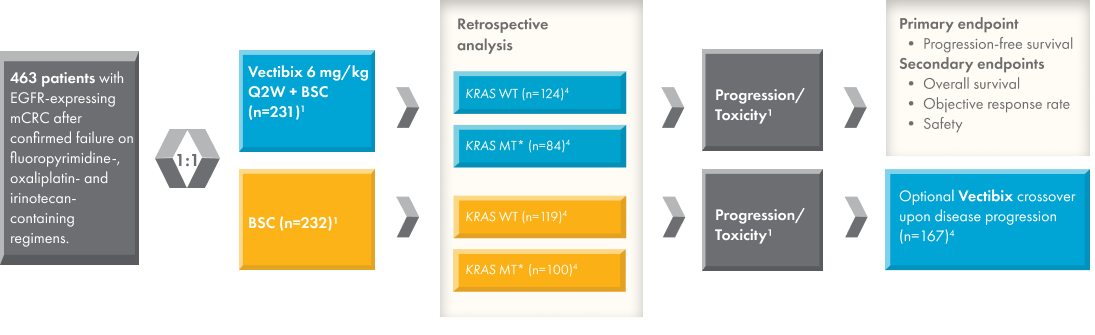

* Vectibix is not indicated for patients with mutant RAS (KRAS/NRAS) or for whom RAS status is unknown.
Adapted from the Vectibix Product Monograph,1 Amado et al.,4 and Van Cutsem et al.5
BSC, best supportive care; EGFR, epidermal growth factor receptor; KRAS, Kirsten rat sarcoma viral oncogene homologue; mCRC, metastatic colorectal cancer; MT, mutant; NRAS, Neuroblastoma RAS viral oncogene homologue; Q2W, every 2 weeks; RAS, Rat sarcoma viral oncogene homologue; WT, wild-type.