408 STUDY
A randomized, open-label, active-controlled, multicentre, phase 3 study1

  • Primary Endpoint
  • Secondary Endpoint
DEMONSTRATED 55% REDUCTION IN THE RISK OF DISEASE PROGRESSION OR DEATH IN PATIENTS TREATED WITH VECTIBIX + BSC VS. BSC ALONE (HR=0.45 [95% CI: 0.34–0.59]; P<0.0001)1,4
 Kaplan-Meier Curve of Progression-Free Survival (PFS) for Vectibix + BSC (n=124) and BSC alone (n=119) in patients with wild-type KRAS mCRC. 
Proportion of event-free patients from 0 to 100 percent. Treatment duration from 0 to 104 weeks. 
In the primary-analysis of PFS, 229 events (disease progression or death) had occurred (115 events in the Vectibix + BSC group [93%]; 114 events in the BSC alone group [96%]). The median PFS for patients in the Vectibix + BSC treatment arm was 12.3 weeks vs. 7.3 weeks in the BSC alone arm.1 
Patients in the Vectibix + BSC arm had significant improvement in PFS over those in the BSC alone arm (HR: 0.45, 95% CI: 0.34–0.90 [stratified log-rank P<0.0001]).1  Kaplan-Meier Curve of Progression-Free Survival (PFS) for Vectibix + BSC (n=124) and BSC alone (n=119) in patients with wild-type KRAS mCRC. 
Proportion of event-free patients from 0 to 100 percent. Treatment duration from 0 to 104 weeks. 
In the primary-analysis of PFS, 229 events (disease progression or death) had occurred (115 events in the Vectibix + BSC group [93%]; 114 events in the BSC alone group [96%]). The median PFS for patients in the Vectibix + BSC treatment arm was 12.3 weeks vs. 7.3 weeks in the BSC alone arm.1 
Patients in the Vectibix + BSC arm had significant improvement in PFS over those in the BSC alone arm (HR: 0.45, 95% CI: 0.34–0.90 [stratified log-rank P<0.0001]).1

Adapted from the Vectibix Product Monograph1 and Amado et al.4

BSC, best supportive care; CI, confidence interval; HR, hazard ratio; PFS, progression-free survival.
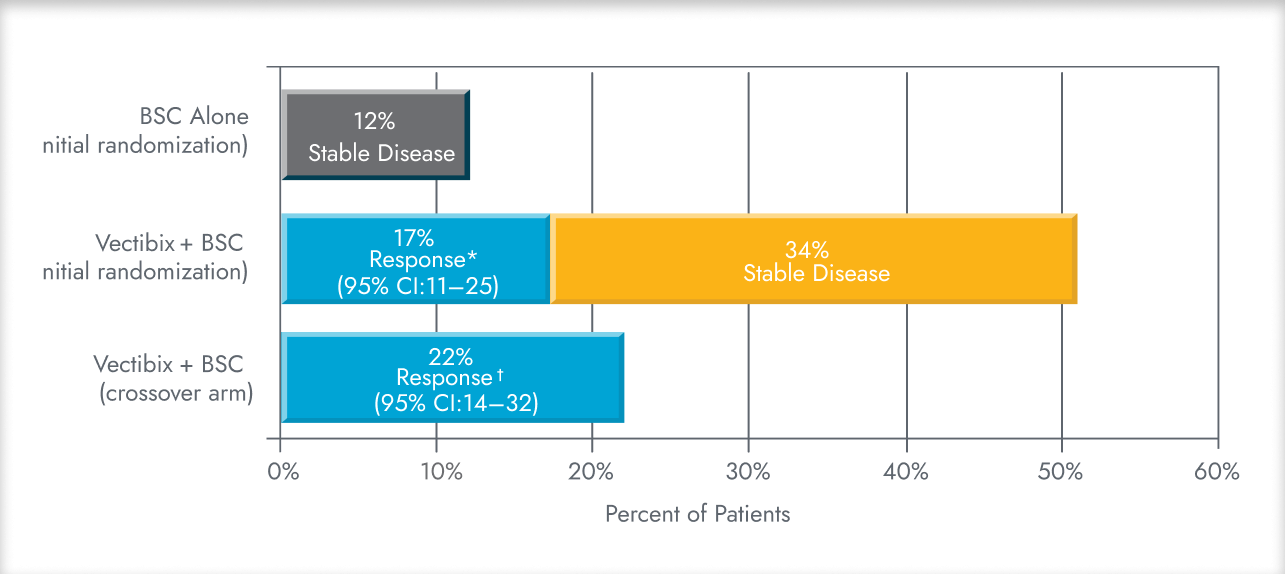
Response rates of 17% and 22% shown in patients treated with Vectibix + BSC
Treatment responses in the wild-type KRAS mCRC patient population. Key results of overall response rate (ORR), which consists of complete and partial response, and stable disease rates for Vectibix + BSC and BSC alone treatment arms. 
Proportion of patients in the original randomization subset that achieved response rates for BSC alone or Vectibix + BSC treatment arms. Response rate in patients that crossed over to VECTIBIX after progression on BSC alone.
Percent of patients with response rates from 0 to 60 percent.
ORR in BSC alone arm (after initial randomization): 12% of patients demonstrated stable disease. 
ORR in Vectibix+ BSC arm: 17% (9/124) of patients demonstrated partial response and 34% demonstrated stable disease.1,4   
ORR in Vectibix + BSC crossover treatment arm:  22% of patients demonstrated treatment response, with 1/91 of patients achieving complete response and 19/91 patients demonstrating partial response rates.4 
Treatment responses in the wild-type KRAS mCRC patient population. Key results of overall response rate (ORR), which consists of complete and partial response, and stable disease rates for Vectibix + BSC and BSC alone treatment arms. 
Proportion of patients in the original randomization subset that achieved response rates for BSC alone or Vectibix + BSC treatment arms. Response rate in patients that crossed over to VECTIBIX after progression on BSC alone.
Percent of patients with response rates from 0 to 60 percent.
ORR in BSC alone arm (after initial randomization): 12% of patients demonstrated stable disease. 
ORR in Vectibix + BSC arm: 17% (9/124) of patients demonstrated partial response and 34% demonstrated stable disease.1,4   
ORR in Vectibix + BSC crossover treatment arm:  22% of patients demonstrated treatment response, with 1/91 of patients achieving complete response and 19/91 patients demonstrating partial response rates.4

Adapted from the Vectibix Product Monograph1 and Amado et al.4
* Complete response 0/124 + partial response 21/124.4
† Complete response 1/91 + partial response 19/91.4

BSC, best supportive care; CI, confidence interval.

mid-bg
STUDY DESIGN
BASELINE
CHARACTERISTICS
Learn about the 408 Study by reading the publication.
Characteristics Vectibix + BSC (n=231) BSC alone (n=232)
Age
Mean age (range), years 61.2 (10.3) 61.4 (10.8)
Gender
Male (n) 146 148
Female (n) 85 84
Ethnicity
White (%) 99 98
Primary Tumour Type
Colon (%) 66 68
Rectal (%) 34 32
All patients (n=463)
Eastern Cooperative Oncology Group (ECOG) Performance Status
0 40%
1 45%
2 14%
3 1%
Prior fluoropyrimidine, irinotecan, and oxaliplatin chemotherapy
2 lines 100%
3 lines 37%
>3 lines 6%
Patient eligibility:4
  • ≥18 years old with pathologic diagnosis of metastatic colorectal adenocarcinoma and radiologic documentation of disease progression during or within 6 months following the last administration of fluoropyrimidine, irinotecan, and oxaliplatin.
  • Adequate exposure to prior chemotherapy, with average dose-intensity of irinotecan (≥65mg/m2 per week) and of oxaliplatin (≥30mg/m2 per week).
  • Two or three prior chemotherapy regimens for metastatic colorectal cancer.
  • Eastern Cooperative Oncology Group (ECOG) performance status (PS) of 0–2.
  • ≥1% EGFR-positive membrane staining in evaluated tumour cells (primary or metastatic) by immunohistochemistry.

BSC, best supportive care; ECOG, Eastern Cooperative Oncology Group.
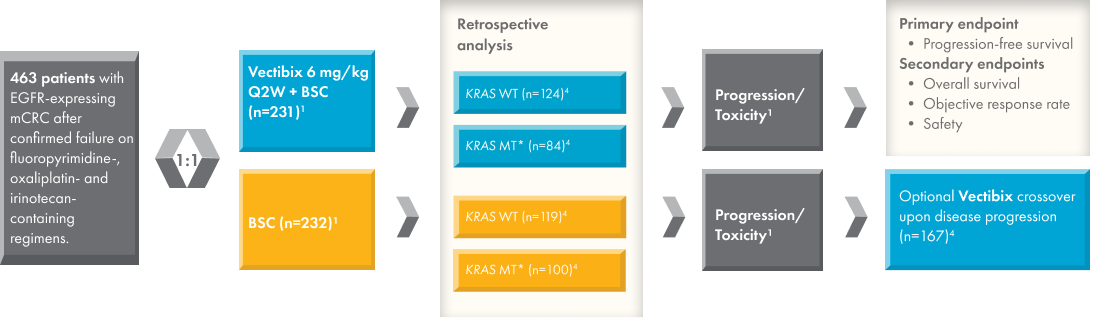
463 patients with EGFR-expressing mCRC after confirmed failure on fluoropyrimidine-, oxaliplatin- and irinotecan-containing regimens were randomized 1:1 to one of two groups: Vectibix at dosing administration of 6 mg/kg every two weeks (Q2W) + BSC (n=231) or BSC (n=232). 
Tumours from the original patient population were retrospectively analyzed by tumour KRAS mutation status.  Of the 427 patients who had a tumour sample analyzed for KRAS, 243 were determined to have wild-type KRAS and 184 were determined to have mutant KRAS. 
Among patients that were randomized to receive Vectibix + BSC, 124 had wild-type and 84 had mutant KRAS; among patients that were randomized to receive BSC alone, 119 had wild-type and 100 had mutant KRAS. 
Duration of treatment was until disease progression or treatment toxicity. 
The primary endpoint was progression-free survival, while secondary endpoints consisted of overall survival, objective response rate, and safety.
Upon disease progression, 167 patients originally randomized to BSC alone treatment arm were eligible to crossover to optional treatment of Vectibix at dosing administration of 6 mg/kg every two weeks (Q2W) + BSC. 463 patients with EGFR-expressing mCRC after confirmed failure on fluoropyrimidine-, oxaliplatin- and irinotecan-containing regimens were randomized 1:1 to one of two groups: Vectibix at dosing administration of 6 mg/kg every two weeks (Q2W) + BSC (n=231) or BSC (n=232). 
Tumours from the original patient population were retrospectively analyzed by tumour KRAS mutation status.  Of the 427 patients who had a tumour sample analyzed for KRAS, 243 were determined to have wild-type KRAS and 184 were determined to have mutant KRAS. 
Among patients that were randomized to receive Vectibix + BSC, 124 had wild-type and 84 had mutant KRAS; among patients that were randomized to receive BSC alone, 119 had wild-type and 100 had mutant KRAS. 
Duration of treatment was until disease progression or treatment toxicity. 
The primary endpoint was progression-free survival, while secondary endpoints consisted of overall survival, objective response rate, and safety.
Upon disease progression, 167 patients originally randomized to BSC alone treatment arm were eligible to crossover to optional treatment of Vectibix at dosing administration of 6 mg/kg every two weeks (Q2W) + BSC.

* Vectibix is not indicated for patients with mutant RAS (KRAS/NRAS) or for whom RAS status is unknown.

Adapted from the Vectibix Product Monograph,1 Amado et al.,4 and Van Cutsem et al.5

BSC, best supportive care; EGFR, epidermal growth factor receptor; KRAS, Kirsten rat sarcoma viral oncogene homologue; mCRC, metastatic colorectal cancer; MT, mutant; NRAS, Neuroblastoma RAS viral oncogene homologue; Q2W, every 2 weeks; RAS, Rat sarcoma viral oncogene homologue; WT, wild-type.